How to Measure Your Well Pump Flow Rate for Softener Compatibility
Step-by-Step Flow Rate Test for Private Wells (Bucket Method, Pitless, Head Pressure)
Minimum Water Flow Rate Required:
The size of an iron filter or pH neutralizer system is dependent on the flow rate from your well pump.
Please check your flow rate to select the properly sized system.
Do not select a system that requires a higher flow rate.
>>>> Get your Flow Rate:
Shut-off all faucets and make sure there is no running water.
Place a 5 gallon bucket by a hose bib (spigot) near your well pump.
Fully open the water hose bib until the well pump starts.
Then, start filling up your 5 gallon bucket, and time how many seconds it takes to fill it up.
Use the chart the following chart to get your flow rate.
Click Here To Know the Importance Of Flow Rate For A Water Softener Used With Well Water
Why Pump Flow Rate Is Crucial When Choosing a Well-Water Softener
The flow rate of a water softener represents the cornerstone of effective well water treatment, directly impacting every aspect of water softening performance. Well water presents unique challenges compared to municipal water supply systems, containing elevated concentrations of hardness minerals, iron, hydrogen sulfide, and other dissolved contaminants that demand precise flow rate calibration for optimal water purification.
Technical Foundation of Flow Rate in Ion Exchange Systems
Water softeners operate through ion exchange technology, where calcium and magnesium ions are exchanged for sodium ions within specialized resin beds. The flow rate determines the contact time between well water and the resin media, directly affecting filtration efficiency. When well water flows through the system at improper rates, the ion exchange process becomes compromised, allowing hard water to bypass treatment and enter your whole house water supply.
Critical Flow Rate Parameters for Well Water Applications
1. Resin Bed Contact Time Optimization
The flow rate must provide adequate contact time for complete ion exchange. Well water typically contains 10-20 grains per gallon of hardness, requiring extended contact periods compared to softer municipal water. Insufficient contact time results in hardness breakthrough, delivering hard water to your kitchen sink, bathroom fixtures, shower, dishwasher, and washing machine.
Flow rates exceeding 5-7 gallons per minute per cubic foot of resin compromise ion exchange efficiency. For well water systems, this translates to specific flow rate requirements: Single bathroom homes: 6-8 GPM optimal flow rate
Multi-bathroom residences: 12-15 GPM for consistent pressure
Large households: 18-25 GPM to maintain water supply during peak demand
2. Backwash and Regeneration Flow Requirements
Well water water softeners require specific flow rates during regeneration cycles to effectively clean resin beds. The control valve must receive adequate flow rate from your well pump to create proper brine flow patterns. Insufficient flow rate during backwash cycles leads to incomplete resin cleaning, reducing salt efficiency and shortening system lifespan.
Brine injection requires precise flow rate control to ensure proper salt dissolution and distribution. Well water systems with inadequate flow rates experience incomplete regeneration, resulting in premature resin exhaustion and increased salt consumption. 3. Well Pump Compatibility and Flow Matching
Well water systems rely on submersible or jet pumps to deliver water through pipes to your water conditioner. The pump's flow rate capacity must exceed your water softener's service flow rate requirements while maintaining adequate pressure for whole house distribution.Well water pumps typically deliver 5-15 GPM, depending on well depth, soil conditions, and pump specifications.
Your water softener must accommodate these flow rate variations while maintaining consistent water purification performance. Mismatched flow rates between well pumps and water softeners create pressure fluctuations that affect shower pressure, dishwasher fill rates, and washing machine cycle times. Impact of Flow Rate on Water Quality and System Performance
4. Hardness Mineral Removal Efficiency
Proper flow rate ensures complete removal of calcium and magnesium from well water, preventing limescale formation in pipes, water heaters, and appliances. Hard water breakthrough due to excessive flow rates causes limescale buildup in your dishwasher, washing machine, and shower fixtures, reducing appliance efficiency and lifespan.
Flow rate optimization prevents water damage from limescale accumulation in copper pipes and valves. Well water with high mineral content requires slower flow rates to achieve complete ion exchange, protecting your plumbing investment and maintaining water quality throughout your home. 5. Specialized Contaminant Removal
Well water often contains hydrogen sulfide, creating sulfur odors that affect taste and drinking water quality. Flow rate adjustments enable water softeners equipped with specialized media to address sulfide contamination while maintaining water softening efficiency.
Iron removal from well water requires specific flow rate parameters to prevent iron fouling of resin beds. Excessive flow rates allow iron particles to pass through filtration media, staining fixtures and affecting water quality in your kitchen, bathroom, and laundry areas.
6. System Longevity and Maintenance Considerations
Proper flow rate management extends water softener component life, particularly control valves, resin beds, and brine tanks. Well water systems operating at optimal flow rates experience reduced mechanical stress, minimizing leak potential and component failure.
Salt efficiency directly correlates with flow rate optimization. Well water water softeners with properly calibrated flow rates consume 30-40% less salt during regeneration cycles, reducing operating costs and environmental impact. Advanced Flow Rate Considerations for Well Water Systems
7. Peak Demand Management
Well water households experience unique flow rate challenges during peak usage periods. Simultaneous operation of shower, dishwasher, washing machine, and kitchen fixtures requires water softeners capable of maintaining flow rates of 15-20 GPM while preserving water quality.
Flow rate distribution affects water pressure throughout your home, influencing shower performance, dishwasher cleaning efficiency, and washing machine cycle effectiveness. Inadequate flow rate capacity results in pressure drops that compromise water softening performance and user satisfaction. 8. Integration with Complementary Treatment Systems
Well water often requires multiple treatment approaches, combining water softening with reverse osmosis, chlorine removal, and specialized filtration. Flow rate coordination between systems ensures optimal water purification without compromising individual system performance. Reverse osmosis systems require specific flow rate parameters for effective filtration, typically 2-4 GPM for residential applications. When integrated with well water water softeners, flow rate management becomes critical for maintaining drinking water quality at your kitchen sink and other tap locations. 9. Environmental and Efficiency Factors
Well water flow rate optimization reduces salt waste and minimizes brine discharge, supporting environmental sustainability. Proper flow rate management ensures efficient salt utilization while maintaining water softening performance.
Operating temperature affects flow rate requirements, with well water temperatures typically remaining constant year-round. This stability allows for precise flow rate calibration that maximizes ion exchange efficiency and salt conservation.
Flow rate optimization represents the foundation of effective well water water softening. Proper flow rate management ensures complete hardness removal, protects appliances from limescale damage, maintains consistent water pressure, and maximizes system efficiency. Well water households investing in properly sized water softeners with appropriate flow rate capabilities enjoy superior water quality, reduced maintenance costs, and extended system life.
The integration of flow rate management with well water treatment creates a comprehensive water purification solution that addresses the unique challenges of well water while providing whole house water quality improvement. From your morning shower to evening dishwasher cycles, proper flow rate optimization ensures consistent, high-quality water supply throughout your home.
SoftPro Well Filter Packages — Match the Right System to Your Water
Which Well Filter Package Fits Your Water Quality Needs?
When a Softener Isn’t Enough — Addressing Iron, pH & Contaminants
Get a water analysis and expert recommendations. It's free and instant.
Water Softener — Core Ion-Exchange System for Well Water
High-Efficient softener system to handle most typical well water needs.
Removes: - Hard Water
- Clear Water Iron, up to 3 PPM
- Manganese, up to 1 PPM
Package includes:
SoftPro Elite Downflow Water Softener
SoftPro Softener + KDF MediaGuard — Multi-Stage Iron & Heavy Metal Removal
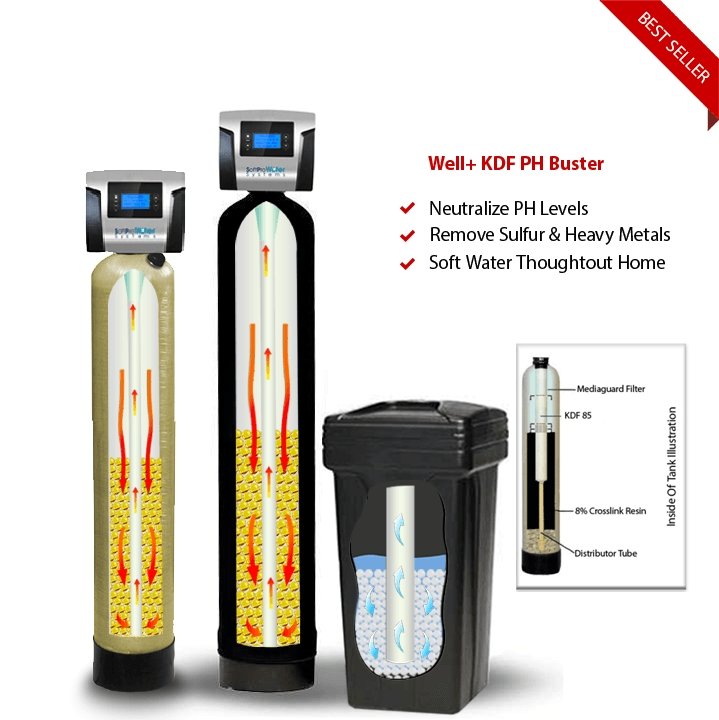
An essential solution to reduce 99% of heavy metals, sulfur and iron content. Additionally, the bacteriostatic media prevents bacteria growth in the system.
Removes: - Hard Water
- Clear Water Iron, up to 3 PPM
- Sulfur, up to 2 PPM
- Manganese, up to 1 PPM
- Prevents bacteria growth
Package includes:
SoftPro Elite Downflow Water Softener
KDF85 MediaGuard Filter (Pre-installed in softener tank. 8% crosslink resin will replace fine mesh resin in the softener tank.)
SoftPro Softener + pH Neutralizer Calcite — Balanced, Stable Water
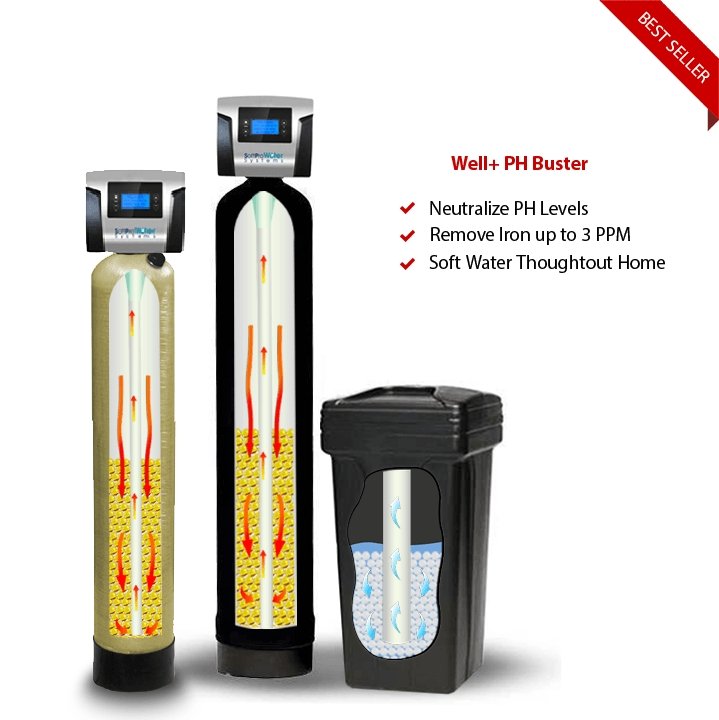
Water softener system that reduces excessive acidic water by raising water's pH levels.
Removes: - Hard Water
- Clear Water Iron, up to 5 PPM
- Sulfur, up to 2 PPM
Treatment solution to treat acidic well water that also contains high levels of iron and/ or sulfur content, while bacteriostatic media prevents bacteria growth in the system.
Removes: - Hard Water
- Clear Water Iron, up to 3 PPM
- Sulfur, up to 2 PPM - Acidic Water, raise pH to 7.0+
Package includes:
SoftPro Elite Downflow Water Softener
KDF85 MediaGuard Filter (Pre-installed in softener tank. 8% crosslink resin will replace fine mesh resin in the softener tank.)
SoftPro pH Neutralizer Calcite Filter
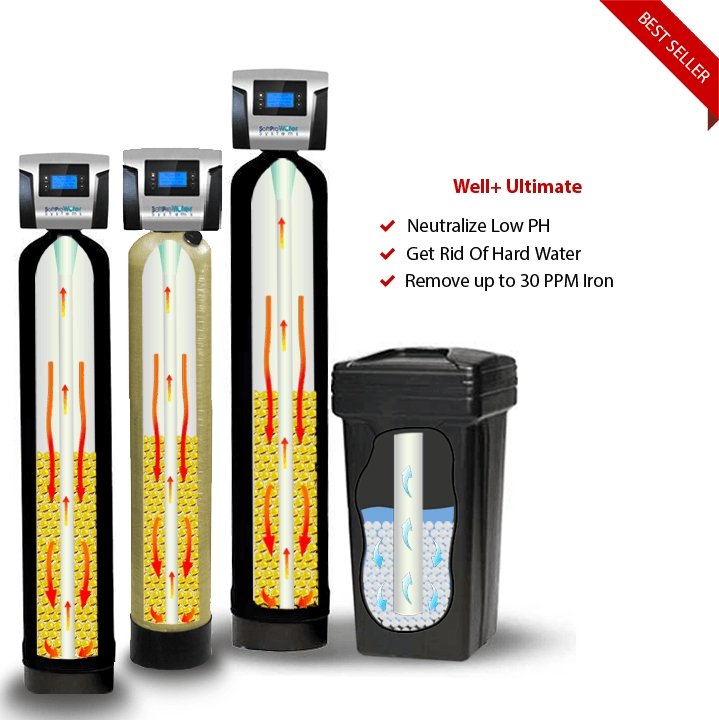
Ultimate All-in-One Well Water Solution — Softener, IronMaster & Neutralizer
For the most complex well water conditions, the Ultimate Package is a great solution.
Removes: - Hard Water
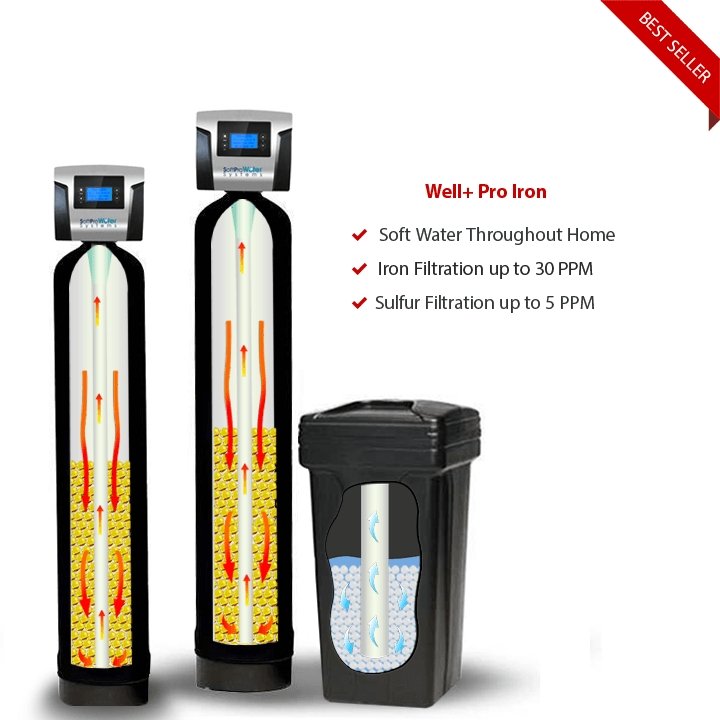
- Iron, up to 30 PPM
- Sulfur, up to 5 PPM
- Manganese, up to 7 PPM
- Acidic Water, raise pH to 7.0+
Package includes:
SoftPro Elite Downflow Water Softener
SoftPro pH Neutralizer Calcite Filter
SoftPro Pro IronMaster
AIO Filter
See what each well water solution package filters out...
Discover The Top Features to Look for in a Whole House Water Softener
Top Features 2025: Digital Metering, Salt Efficiency, Bypass Valves, NSF Ratings & Diagnostic Alerts
Choosing the right whole house water softener is essential to ensure clean, soft water throughout your home. A high-quality system not only removes hardness minerals like calcium and magnesium but also addresses other contaminants that may affect water quality and prevent water damage to your plumbing and appliances.
Hard water contains high levels of dissolved minerals that can cause significant issues throughout your home. These minerals create scale buildup in pipes, reduce soap effectiveness, cause skin irritation, and decrease the lifespan of your washing machine and other appliances.
Understanding the water supply characteristics in your area is crucial for selecting the appropriate system.
For homeowners with private wells, water softeners for well water must address unique challenges. Well water often contains additional contaminants like iron, hydrogen sulfide, copper, and varying levels of sodium. A comprehensive well water filtration and softener system or well water filter and softener combination provides optimal protection.
Many homeowners opt for a well softener system that includes both water softening and water purification capabilities to handle the complex nature of well water sources.
Municipal tap water users also benefit from whole house systems, as city water often contains chlorine and other treatment chemicals that affect taste and odor. Some homeowners consider reverse osmosis systems alongside their water softener for comprehensive treatment.
The operating temperature range and pressure requirements of your home's plumbing system should match your chosen water softener specifications. The control valve and backwashing mechanisms are critical components that determine system efficiency and maintenance requirements. Regular backwashing helps maintain optimal performance and extends system lifespan.
A quality water conditioner whole house system serves as an excellent home improvement investment, protecting your plumbing infrastructure and improving water quality for drinking, cooking, and bathing. The reduction in salinity and mineral content helps preserve toilet fixtures, prevents soil staining from irrigation, and maintains proper water chemistry throughout your home.
For comprehensive water treatment, many homeowners choose a well water filter and softener systems approach or well water filter softener system that combines multiple treatment methods. A well softener paired with additional filtration provides complete protection against various contaminants. Whether you need a water conditioner for well water or a standard residential system, SoftPro offers solutions tailored to your specific water treatment needs.
Below are the key features to consider when selecting a whole house water softener.
1. Capacity & Flow Rate
The capacity of a water softener, measured in grains, determines how much hardness it can remove before requiring regeneration. Larger households or homes with high water usage will need a system with a higher grain capacity.
Similarly, the flow rate, measured in gallons per minute (GPM), should match your household's peak water demand to maintain consistent pressure and performance.
2. Regeneration Type
Water softeners use either time-based or demand-initiated regeneration:
✓ Time-Based Regeneration: Regenerates at set intervals, regardless of water usage. While predictable, it may waste salt and water if usage varies.
✓ Demand-Initiated Regeneration: Regenerates only when needed, based on actual water usage. This option is more efficient and cost-effective.
3. Resin Type & Quality
The resin bed is the core of any salt-based water softener. High-quality resins are more durable and effective at removing hardness minerals. Some systems also offer specialty resins designed to handle additional contaminants like iron or manganese.
4. Advanced Filtration Options
Many whole house systems now include additional filtration capabilities to address other impurities commonly found in well or municipal water, such as chlorine, sediment, iron, sulfur, and manganese.
These features enhance overall water quality while extending the lifespan of plumbing and appliances.
5. Certification
Look for systems certified by third-party organizations like NSF/ANSI. Certifications ensure the system meets industry standards for performance and safety.
Fleck Well Water Solution Packages — Neutral Comparison & Alternatives
Which Fleck Well Water Package Suits Your Well Water? (For Comparison)
Which package should you buy? Get our free, instant Recommendation & Water Analysis Report.
Well Water Basic Package — Budget Treatment for Mild Iron Issues
High-Efficient softener system to handle most typical well water needs.
Reduces:
- Hard Water
- Clear Water Iron, up to 3 PPM
- Manganese, up to 1 PPM
Package includes:
Fleck 2510 SXT Downflow Water Softener
Well Water KDF MediaGuard Filter — Targeting Metals & Odor
Reduce 99% of heavy metals, as well as reducing sulfur and iron content. Additionally, the bacteriostatic media prevents bacteria growth in the system.
Reduces: - Hard Water
- Clear Water Iron, up to 3 PPM - Reduces Sulfur - Manganese, up to 1 PPM - Prevents bacteria growth
Package includes:
Fleck 2510 SXT Downflow Water Softener
KDF85 MediaGuard Filter (pre-installed in softener tank. 8% crosslink resin will replace fine mesh resin.)
Well Water pH Neutralizer (Calcite) — Control Acidity & Corrosion
No more acidic water. Raise pH levels, remove up to 5 PPM of iron and 2 PPM of Sulfur.
Reduces:
- Hard Water
- Clear Water Iron, up to 5 PPM
- Manganese, up to 1 PPM
Package includes:
Fleck 2510 SXT Downflow Water Softener
Fleck 2510 pH Neutralizer Calcite Filter
Well Water AIO Iron Filter — Oxidation for Heavy Iron & Manganese
For well water with extremely high levels of iron, sulfur, manganese and/ or hydrogen sulfide.
Reduces: - Hard Water
- Iron, up to 30 PPM
- Sulfur, up to 5 PPM
- Manganese, up to 7 PPM
Package includes:
Fleck 2510 SXT Downflow Water Softener
Fleck 2510 SXT AIO Iron Filter
Well Water Dual Package — KDF + pH Neutralizer Combo
Treatment solution to treat acidic well water that also contains high levels of iron and/ or sulfur content, while bacteriostatic media prevents bacteria growth in the system.
Reduces:
- Hard Water
- Clear Water Iron, up to 3 PPM
- Sulfur - Manganese, up to 1 PPM - Acidic Water, raise pH to 7.0
- Prevents bacteria growth
Package includes:
Fleck 2510 SXT Downflow Water Softener
KDF85 MediaGuard Filter (pre-installed in softener tank. 8% crosslink resin will replace fine mesh resin.)
Fleck 2510 pH Neutralizer Calcite Filter
Well Water Ultimate Solution — Complete Iron, pH & Contaminant System
For the most complex well water conditions, the Ultimate Package is a great solution, which helps to protect your plumbing system.
Reduces: - Hard Water
- Iron, up to 30 PPM
- Sulfur, up to 5 PPM
- Manganese, up to 7 PPM
- Acidic Water, raise pH to 7.0
Package includes:
Fleck 2510 SXT Downflow Water Softener
Fleck 2510 pH Neutralizer Calcite Filter
Fleck 2510 SXT AIO Iron Filter
See what each well water solution package filters out...